




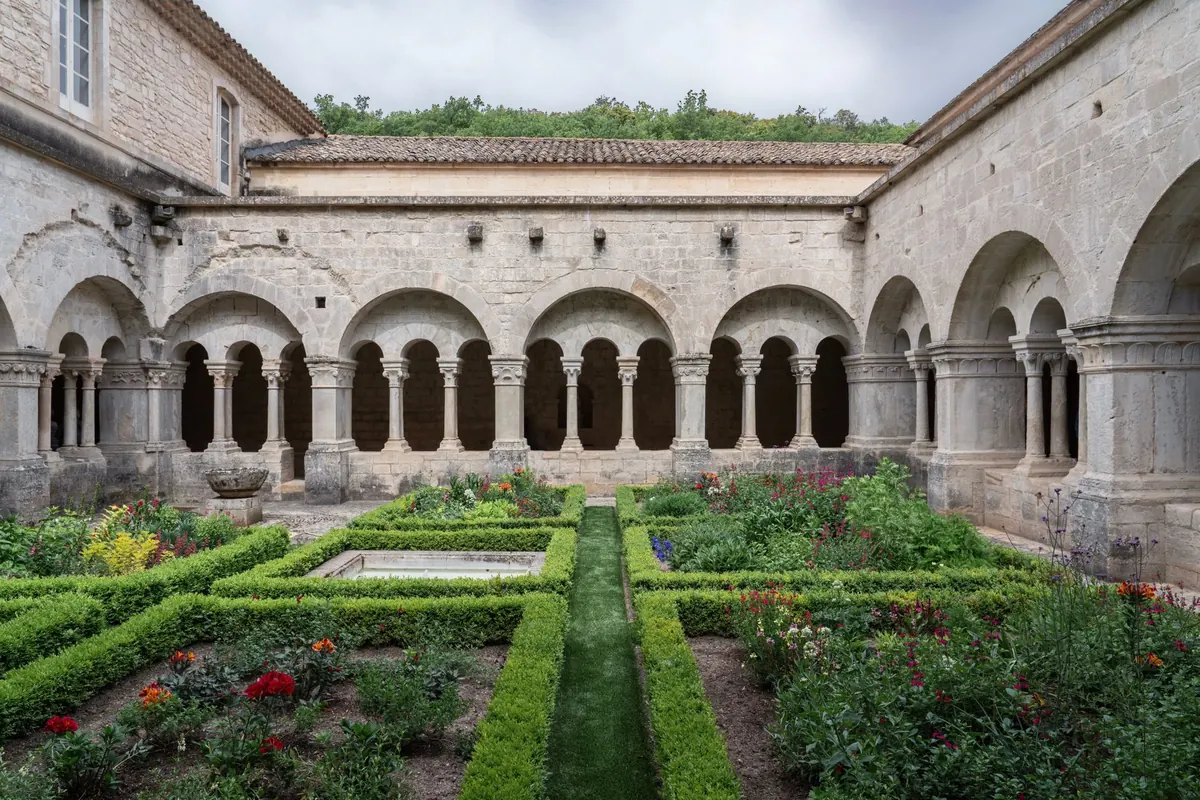
An abbey garden keeps two calendars at once. One is liturgical — Advent, Lent, Easter, Michaelmas — and the other is plain agricultural: sowing, blossom, hay, harvest. Walk the same beds in February and you will find bare espaliers and empty physic squares; return in July and the ground is heavy with roses, herbs and swelling fruit. That double rhythm is why these gardens reward more than one visit. What follows is a seasonal guide to what is actually in flower, what is being gathered, and when you can have the place more or less to yourself.
Winter: Structure, Snowdrops, and the Cloister Garth
From January to early March the garden shows its skeleton, which is exactly what makes it worth seeing. The ninth-century plan of St Gall — the best surviving diagram of an ideal monastic garden — sets out a physic garden beside the infirmary, a kitchen garden with vegetables and fruit trees, and a cloister garth at the centre. Most abbey gardens you can visit today, ruined or still working, follow some version of that arrangement.
The cloister garth was never ornamental in the modern sense. It was a practical, enclosed space: a place for quiet reading, for a central well or lavabo, and often for a single tree — a yew, a cedar, or an apple — that gave the community shade and a focal point. In winter, with the herbaceous growth cut back, you can read the bones of that design. Paths that seemed hidden in summer reappear. The geometry of beds, the line of a wall, the position of a gate: all become legible.
In the beds, look for hellebores, winter aconite, witch hazel and the coloured stems of dogwood. Snowdrops naturalise in rough grass and under orchard trees, often in sheets where the ground has not been dug for decades. Espaliered apples and pears are at their most legible now, trained flat against warm walls. If the garden has a winter garden or a sensory bed, this is the season to use it — scent from wintersweet or sarcococca carries further in cold, still air.
This is the quietest stretch of the year; weekday mornings in January and February are empty even at famous sites. Remember that a working monastery is not a museum. If the church or chapter house is in use, step back and keep your voice down. Candlemas on 2 February is a good day to pair a garden walk with a service.
Spring: Blossom, Herb Beds, and the First Cuttings
March arrives with daffodil drifts, then primroses, cowslips and wallflowers. April and May belong to the orchard. A single old apple or pear tree in full flower against a stone wall can justify the whole trip, and abbey orchards tend to hold older varieties you will not find in a supermarket — 'Ashmead's Kernel', 'Blenheim Orange', 'D'Arcy Spice'. Many were planted for storage and cider as much as for eating fresh, which tells you something about the monastery's economy.
The physic and kitchen beds
Spring is when the herb beds come back to life. Watch for hyssop, sage, rue, rosemary, tansy, chamomile, comfrey and marigold, along with dye plants such as woad, madder and weld. Many are labelled, which turns the beds into a slow, readable walk rather than a quick one. The labels often give both the medieval and modern names, and sometimes the ailment the plant was meant to treat — a reminder that the infirmarian's garden was a pharmacy before it was a pleasure ground.
Resist the urge to taste anything, even when it looks like a kitchen herb. These plantings are for study and display, and not everything in an old physic bed belongs in a salad. Some, like rue and tansy, are toxic in quantity. Others, like comfrey, were used externally. The rule is simple: look, photograph, ask a gardener, but leave the picking to the professionals.
Early Summer: Roses, Climbing Plants, and Long Evenings
June and July are the garden's high season, and stone walls are the reason. Masonry holds warmth, so roses, jasmine, clematis and figs thrive against cloister arcades. Lavender and pinks edge the paths, irises stand in the borders, and everything is loud with bees. The old roses — gallicas, damasks, albas — are especially worth seeking out. They flower once, briefly, but with a scent that modern repeat-flowerers rarely match.
Look for bee boles — the small recesses built into old walls to hold straw skeps. They are easy to miss until someone points them out, and they are one of the most quietly convincing details of a garden that was always meant to be productive. Some gardens now use them again, with observational hives or solitary bee hotels tucked into the same niches.
Midsummer itself, around 24 June, was a major feast in the monastic calendar. St John's Wort was traditionally gathered on St John's Eve, hung in doorways, and used for oils and tinctures. In the garden, you may see it flowering alongside other plants tied to the feast: mugwort, vervain, yarrow. The long evenings are also the best time to visit if you want the place to yourself. Many abbey gardens close at dusk, but a few open late for concerts or quiet evenings, when the stone walls glow and the scent of roses and lavender hangs in the air.
Late Summer and Autumn: Harvest, Seed Heads, and Michaelmas
August is abundance, sometimes to the point of chaos. Lavender is cut and dried, fruit ripens, and the kitchen beds produce beans, kale, onions and leeks. This is when you see the garden working hardest. If there is an orchard, windfalls appear under the trees and wasps circle the fruit. The physic beds are full of seed heads — poppies, nigella, angelica — and the dye plants are ready for harvest.
September brings Michaelmas on the 29th, the traditional end of the harvest and the start of autumn. In abbey gardens, Michaelmas daisies (now more accurately called asters) flower in blue and purple, and the last roses are out. Apples and pears are picked and stored. Nuts — hazel, walnut, sweet chestnut — are gathered. The light softens, and the garden takes on a mellow, slightly wistful quality.
October and November strip the garden back again. Seed heads stand in silhouette — teasel, cardoon, honesty — and hips, haws and berries colour the hedges. The leaves of espaliered trees turn gold and fall. By late November the structure is visible once more, and the cycle begins again. If you visit on a dry, frosty morning, you may have the whole place to yourself, with nothing but the crunch of gravel and the call of a robin.
A Month-by-Month Quick Reference
- January: Hellebores, winter aconite, snowdrops (early), bare espaliers, cloister garth structure.
- February: Snowdrops in sheets, Candlemas, witch hazel, dogwood stems.
- March: Daffodils, primroses, cowslips, first herb shoots.
- April: Orchard blossom, wallflowers, tulips, herb beds filling out.
- May: Peak blossom, alliums, early roses, dye plants emerging.
- June: Roses (gallic, damask, alba), lavender, bee boles, Midsummer herbs.
- July: Lavender and pinks, climbing roses, figs, long evenings.
- August: Harvest, seed heads, ripe fruit, dye plants.
- September: Michaelmas daisies, apples, pears, nuts, last roses.
- October: Autumn colour, hips and haws, seed heads.
- November: Berries, structure, frosty mornings.
- December: Evergreens, ivy, quiet, Advent.
Practical Notes for Visiting Abbey Gardens
- Check opening times. Many abbey gardens are run by trusts or volunteers and may close in winter or open only on certain days. Some are attached to working churches or monasteries, so hours can change.
- Respect worship. If a service is taking place, do not enter the church or chapter house. Even in the garden, keep voices low near windows and doors.
- Do not pick or taste. These are living collections, not allotments. Leave the plants for everyone.
- Bring a hand lens or a phone camera. Labels can be small, and the detail — the hairs on a leaf, the structure of a seed head — rewards close looking.
- Ask the gardeners. If you see someone working, ask what is in season or what they recommend. They often know the garden's history better than any guidebook.
An abbey garden is never just one thing. It is a pharmacy, a larder, a place of prayer, and a work of art that changes every week. The trick is to go often enough to notice. Pick a month, pick a day, and let the double calendar do the rest.
Related posts
More stories you’ll love reading